You bought a 1W or 2W low-power mini solar panel, hooked it up, and the outcome was, to put it mildly, disappointing. The battery barely charges, the device shuts off right when you need it… and the obvious thought is: “I’ve been scammed! This panel doesn’t deliver what it promises.”
If you’re reading this, chances are you’re part of the legion of makers and tinkerers who’ve dreamed of powering a monitoring project (like a sensor with an ESP32 or an ESP8266) using solar energy, with those small and eye‑catching panels sold for ridiculously low prices on platforms like AliExpress.
In this analysis, we’re going to bust this popular belief. Here’s the spoiler: the power rating advertised by the seller of AliExpress solar panels is, in all likelihood, real and legitimate. The issue isn’t that the manufacturer is lying, but rather a misreading of the specifications and the electronics we use to draw that energy.
Contents
The Hidden Secret in the Datasheet: Wpeak (Peak Power) and STCp and the STC
When you buy a solar panel, the key fact is its Peak Power ( o
o  ). This is the wattage that you see advertised in the title of the product. But this value comes from an artificial condition that is rarely, if ever, fulfilled on your balcony or in the mountains: the Standard Test Conditions (STC).
What do Standard Test Conditions (STC) mean?
STCs are the international standard under which all solar panels (large or small) are tested in a laboratory. They are defined by three crucial factors:
- Solar irradiance:
 . This is equivalent to the midday sun on a clear, cloudless day at the equator, pointing perfectly at the panel.
 - Air Mass (AM):
 . It is a measure of the distance that sunlight has to travel through the atmosphere, simulating a solar position of
  over the horizon.
 - Cell Temperature:
 . This factor is highly misleading! A solar panel exposed to irradiance is seldom maintained at temperature at the cell surface; it is generally much hotter, which reduces its efficiency.
If the seller indicates that the panel is made of  means that in these perfect laboratory conditions (which no you are going to get for your project), that panel is capable of generating .
Analysis of the 60 x 110mm solar panel
Let's take as an example a small panel with dimensions of  which is typically sold as
  .
.
Calculation of Solar Input Potential
First, we convert the area to square metres to use the standard unit of irradiance:
![\[\text{Area} (A) = 60 \text{ mm} \times 110 \text{ mm} = 6600 \text{ mm}^2 = 0.0066 \text{ m}^2\]]](https://emariete.com/wp-content/ql-cache/quicklatex.com-c306a8f3fae74cf0b9de80d0c71bb4c2_l3.png "Rendered by QuickLaTeX.com")
We calculate the total solar energy (in power) incident on the panel under STC:
![\[P_{\text{incidente}} = 1000 \frac{\text{W}}{\text{m}^2} \times 0.0066 \text{ m}^2 = 6.6 \text{ W}\]](https://emariete.com/wp-content/ql-cache/quicklatex.com-f83b0fbe4c5c0fce3b6f12bc33da549f_l3.png "Rendered by QuickLaTeX.com")
Calculation of Required Efficiency
If the manufacturer advertises that it is a solar panel of ( ) and receives
  of light (
 ), we can calculate the efficiency (
 ) required:
![\[\eta = \frac{P_{\text{out}}}{P_{\text{in}}} \times 100 = \frac{1 \text{ W}}{6.6 \text{ W}} \times 100 \approx 15.15\%\]](https://emariete.com/wp-content/ql-cache/quicklatex.com-7a6cbe86d635fa6b1ba3130cb5287f99_l3.png "Rendered by QuickLaTeX.com")
Verdict: An efficiency of  is a value realistic and achievable for currently manufactured polycrystalline or monocrystalline silicon cells. No cutting-edge technology is required to achieve this.
Partial Conclusion! The seller NO is lying to you with the figure of
) and not a guarantee of real-life performance.
The Human Factor: The I-V Curve and the Cruelty of the MPP
If the seller is not lying, why do we get only  o
o  at home? The reason is twofold: Actual (non-STC) Conditions and, most importantly, poor load management.
The Impact of Actual Conditions
In real life, the panel has two enemies that drastically reduce its performance:
- Variable Irradiance: In most regions and at most times of the day, irradiance is much lower than the . The sun at 10 o'clock in the morning or a slightly overcast sky will reduce the power by half or less.
- High Temperature: For every degree Celsius above the (STC), the performance of the silicon cell falls between a
 and a
and a  . On a hot summer's day, your panel can easily be overheated.
  which means an automatic loss of the
  at
at  of full power, even in bright sunshine.
Royal Example (Madrid, 7 December):
The graph of the weather station at my home in Madrid, Spain, on 7 December 2025 (winter) shows that the maximum solar radiation reached was  at 14:20hand only for a brief moment.
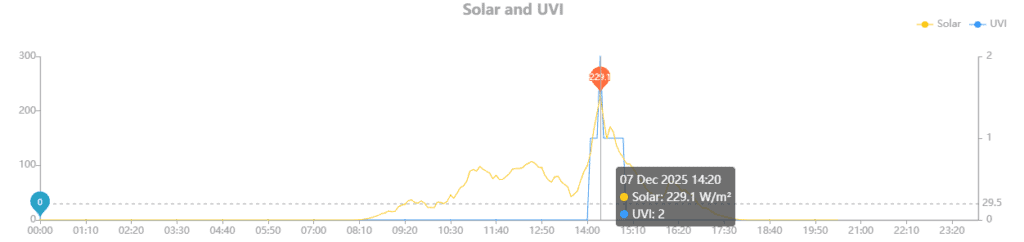
If your panel is  is based on
  at the peak of that day you only received the
  of the rated power (
 ).
).
That is to say, your panel of only produced, at most,  . And this was only at one point in the day, the rest of the day produced much less energy.
The Maximum Power Point (MPP) Trap
This is the key point, just as we saw in the post about Low-Power Solar Panels and MPPT. A solar panel isn’t an ideal power supply; its maximum output ( ) is only delivered at one specific point on the Voltage-Current curve (I-V curve), known as the Maximum Power Point (MPP).
- If you connect it short-circuited (no load): You will get the maximum current (
 ), but the voltage will be
  . Power (
 ) will be
  .
. - If you leave it in open circuit: You will get the maximum voltage (
 ), but the current will be
  . Power () will be .
The Problem of Direct Battery Charging
If you connect the  directly to a lithium battery (
 The battery will act as a load which sets the panel voltage to its actual value (e.g,
  ).
).
If the panel has its MPP at  by forcing it to operate at (battery voltage), you are forcing it out of its optimum power point. You are leaving a large part of the generatable energy on the table.
The power you get is always
and only in the MPP is this figure at its highest (
The Solution is the Electronics, Not the Panel: The MPPT Charger
This is where the post links to the solution we advocate: in order to extract the (or the maximum available at any point in time) of your mini solar panel from AliExpressyou need smart electronics.
The chip that allows you to obtain the real energy of the solar panel, irrespective of the irradiance is the Maximum Power Point Tracker (MPPT).
How does MPPT work in Low Power Panels?
- Dynamic Scanning: The MPPT circuit continuously measures the panel output (
 e
e  ) and recalculates the exact point where
  is maximum.
 - Energy Transformation: If the MPP is at
 and the battery is
  A simple charger would discard the power. An MPPT takes that maximum power (
 ), transforms it and delivers it to the battery. The power is maintained; if you reduce the voltage, the current increases (and vice versa).
![\[P_{{MPP text}} = V_{MPP text}} \times I_{{MPP text}} = V_{Battery_text}} \times I_{Battery_text}} \text{ (minus losses)}]](https://emariete.com/wp-content/ql-cache/quicklatex.com-b6c5952c5d206295e1369ea08d80c73b_l3.png "Rendered by QuickLaTeX.com")
In the context of the low power panels on AliExpress, an MPPT charger such as the popular CN3971 , MCP73871 or the BQ25504 allow:
- Increasing load efficiency by up to
 compared to a basic linear charger.
 - Making the most of energy even on cloudy or low-light days, extracting the last available milliwatts.
Note that when the solar panel is installed in conditions that are not even the best for the location or time of year (shaded or long shaded sites or poorly oriented to the sun), the solar panel may not be suitable for the location or time of year, MPPT may be the only viable solution.
Conclusion: The Truth Behind the Deception (You Have the Power)
The answer to the question: "Are the AliExpress sellers cheating us?" is, in general, a resounding NO. They sell you a panel that, under the STC standard, can reach that power rating ().
The problem lies in the misunderstanding of three factors:
- STCs are a laboratory standard.
- The output of a solar panel is not fixed, it is an optimum point (MPP).
- Without MPPT electronics, you will never reach either the rated power or the actual maximum power under sub-optimal conditions.
If your ESP32 solar sensor project continues to fail, the solution may not be to buy a bigger panel, but rather to investing in an MPPT charging circuit and optimise your code to use low-power modes (Deep Sleep) and hardware to make it as efficient as possible. It's the only way to ensure that every ray of sunshine is converted into the maximum possible energy for your battery.
And watch out, because just like in life (and not only related to China) there are always “smart sellers” and marketing exaggerations. Of course, you’ll come across 1W panels labeled as 10W, but now that you’ve read this post, you know that the energy a solar panel can produce is directly proportional to its size, and that there aren’t huge differences between them—or magical panels that defy physics. A panel the size of your hand can’t power a laptop, and if someone tries to sell you a 10×10 cm panel claiming it’s 25W, you now know that’s simply not true.
What next?
If you want to learn more about how the MPPT circuit is the real secret to making your 1W project work, be sure to read the following post.
I sincerely believe that is a must.